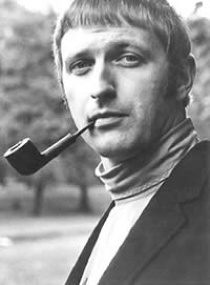
|
|
|
|
Name: Graham Chapman |
|
|
|
|
Name: Graham Chapman |

Graham Chapman was born on January 1941
at the Stoneygate Nursing Home in Leicester, in the middle of an air raid. Chapman’s father was a policeman and as a result, Graham (and older brother John) moved around the country to where their father’s postings took them. Although as a consequence they both attended many different schools, it seems that the one that provided the most influence to Graham was Melton Mowbray Grammar. It was here that Graham picked up the theatrical bug, becoming involved in the regular Gilbert and Sullivan, Shakespeare and revue shows the school held. Around this time, Chapman saw a clip of a Footlights show on television and decided that he wanted to go to Cambridge. He also, like most of the other Pythons, discovered
The Goon Show, which was to so influence their work (Chapman once confessed that "from about the age of seven or eight I used to be an avid listener of a
radio programme called The Goon Show. In fact, at that stage I wanted to be a Goon").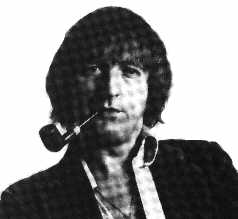
Encouraged by his headmaster Mr. Brewster, Chapman applied to Cambridge, and in 1959 without much trouble was admitted to Emmanuel College to read medicine. Immediately Chapman set about joining the Footlights. However, his first contact with them, at the Fresher's Fair was a dismal failure after being turned down for membership by the club secretary (a Mr. David Frost). Not disheartened, Chapman teamed up with fellow student Anthony Branch to write their own “smoker” (“unofficial” revues that acted as a preliminary audition for those aspiring to Footlights membership). Chapman and Branch invited the Footlights committee, and impressed them enough to be elected to audition, and from there to be admitted as members. John Cleese (who had taken a year to get into Footlights) also attended the audition. The two met up afterwards in a coffee shop, and a new writing partnership was formed.
In 1962, Chapman and Cleese wrote and performed in the revue
Double Take (alongside amongst other Humphrey Barclay, Tim Brooke-Taylor and Miriam
Magoyles, and directed by a young Trevor Nunn). Some of the material they wrote for this show as later re-used for
I’m Sorry I’ll Read That Again and Not The 1948 Show.
That summer Chapman moved to London to continue his studies as a trainee doctor. He still managed to perform in cabaret, teaming up with
Double Take veteran and future Spitting Image co-creator Tony
Hendra. In 1963 Chapman was offered a part in the revue show A Clump of Plinths in the West End (now re-named
Cambridge Circus), after another member of the cast dropped out. Chapman would stay with the show for three months. Then he was offered a choice – continue with
Cambridge Circus on its tour of New Zealand, or carry on with his medical training. Chapman eventually managed to do both by negotiating a year off from college, and went to New Zealand (and also eventually to Broadway). After a year of touring, he returned to London to complete his training.
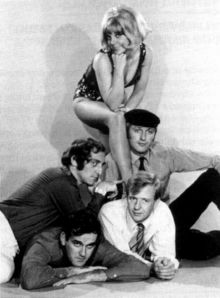
Upon graduation, Chapman decided to continue with his new show business career rather than his medical one (in part because doing the required years residency would have been financially crippling). Along with John Cleese, Chapman quickly got a job writing for television, including
That Was The Week That Was, some episodes of the Doctor series (no doubt Chapman’s medical training coming in handy), Ronnie Corbett’s series Look Here Now, gags for
The Petula Clark Show, additional material for the film The Magic Christian (starring Ringo Starr and Peter Sellers) and the movie
The Rise and Rise of Michael Rimmer. Along with Cleese, Graham Chapman was recruited into the writing team for
The Frost Report, alongside fellow Pythons Eric Idle, Michael Palin and Terry Jones. After the
Frost Report, Chapman moved on to be a writer and performer in At Last The 1948 Show (with John Cleese, Tim Brooke Taylor, Aimi MacDonald and Marty Feldman). Then a man called Barry Took came along, assembled 6 comedy writers and comedy history was made…
All throughout this time, Chapman struggled with the problem of alcoholism, which had steadily escalated since his time at Cambridge. By the time of filming
Monty Python and The Holy Grail, it was so bad that it sometimes affected his
performances (according to Terry Gilliam, Chapman would forget his lines, and was
so drunk during filming that he was unable to make it across the Bridge of
Death, requiring the assistant cameraman to double for him), and that if he went without drinking for any length of time he would go into withdrawal.
Saying that it had to be said that Chapman’s drinking did help avert a mutiny on set. Because of the conditions everyone was filming in at the time - cold and wet, everyone was getting so miserable they started threatening to leave. At this point Chapman bought everyone a drink in the local pub and led them in a rousing sing-song, thus reuniting the team
spirit.
One of Chapman’s greatest supports during this period was his long-term partner David Sherlock (who was also joint guardian of Chapman’s adopted son John
Tomiczek). Chapman had been a practising homosexual since his mid-twenties (he
was openly gay way before it was considered socially acceptable), and he embraced his sexuality, becoming a founder member of
Gay News and an active campaigner for gay rights.
In 1977 Chapman (with frankly superhuman effort) gave up drinking almost overnight. Even without the drink, Chapman’s humour was always the most surreal of any of the Pythons – after all who else would turn up to a speaking engagement dressed as a giant carrot, and stand in silence for 10 minutes before leaving again? Still, his next Python role, in The Life of Brian, could is considered by many to be the peak of his career.
Post-Python
|
Graham Chapman in (the sadly unmade) Jake's Journey |
Unlike the rest of the Python team, Chapman did not move on to anything even half as successful. His only solo movie project, the film
Yellowbeard, was a critical and commercial failure. A potential series for US television called
Jake's Journey never made it beyond a pilot (although given that it would have also starred Peter Cook, the question as to be asked - why wasn't it made?) The only real post-Python success came in America and Australia, on college lecture tours formed out of the question and answer sessions started Chicago whilst plugging his autobiography
A Liar’s Autobiography., In them he spoke about such differing subjects as his time with Monty Python, his homosexuality, his friendship with The Who's Keith Moon, hurtling down a mountain in a gondola with the Dangerous Sports Club and the hilarious game "shitties". A recording of one has since been
released under the title
Looks Like A Brown Trousers Job.
In November 1988, Chapman was diagnosed with throat cancer. This swiftly spread to his spine. Despite prolonged and painful treatment, Chapman continued working, appearing in the Python compilation
Parrot Sketch Not Included. In September 1989, the cancer was declared incurable and two months later on October 4, he died, Michael Palin and John Cleese by his side.
The rest of the Python team decided to stay away from his funeral, to avoid it becoming a media circus and to give Chapman’s family some privacy (although they sent a wreath in the shape of the famous Python foot, with the message “To Graham from the other Pythons. Stop us if we’re getting too silly”). Instead they held a memorial service two months later in St Bart’s Hospital Great Hall, with choruses of “Always Look On The Bright Side of Life” and Chapman’s favourite “Jelusarem” (the Chinese version of Jerusalem, reading "… Bling me my speal, oh crowds unford. Bling me my chaliots of file…", and with John Cleese’s address including the immortal words “Graham Chapman is no more. He has gone to meet his maker. He has run down the curtain and join the choir invisible” (Cleese was also the first person to say “fuck” at a memorial service). Eric Idle, choking back tears, also said of Chapman that he had thought that Michael Palin talked too much and had died rather than listen to him any more.
It was a send-off appropriate for a man, who more than any other Python, lived the lunacy that the show depicted.